Discover how Google DeepMind is transforming AI and impacting our daily lives in unexpected ways.
Artificial intelligence (AI) is already part of our lives, helping us with daily tasks and changing how we work and entertain ourselves. However, one of the most promising initiatives in this field is Google DeepMind, a company taking AI to a new level. Wondering how? In this post, we’ll explore what DeepMind is, its most impactful achievements, and the role it plays in the future of AI.
In 2015, Alphabet, which is the parent company of Google, bought DeepMind, an artificial intelligence (AI) research company. Founded and headquartered in London in 2010, DeepMind is known for its significant contributions to AI research and development. The company’s primary focus is on machine learning and deep learning.
The company’s primary goal is to create an AI that can learn and reason like humans. This could lead to more intelligent systems capable of solving complex problems.
In this article we will delve a little deeper into Google DeepMind and its fundamental contributions to AI.
What is Google DeepMind?
DeepMind is an AI research company that seeks to mimic human ability to solve complex problems. Founded in 2010 and acquired by Google in 2015, its focus on “general-purpose AI” allows its systems to perform a variety of tasks without requiring specific programming, making its AI adaptable and flexible.
Notable achievements: far beyond games
One of DeepMind’s first achievements was AlphaGo, a system that in 2016 defeated the world champion of Go, a game famous for its complexity. This milestone demonstrated that AI can not only learn but also compete in tasks requiring creativity and intuition. Since then, DeepMind has made progress in diverse fields: its AI AlphaFold has revolutionized biology by predicting protein structure, a key advance in medicine that opens doors to new treatments and personalized therapies.
How does DeepMind technology work?
DeepMind’s approach is based on two pillars: deep learning and reinforcement learning. These methods allow AI to improve through trial and error, without receiving specific instructions for each problem. Furthermore, it uses advanced neural networks that help identify complex patterns and make informed decisions.
Thanks to these methods, DeepMind has made significant progress in areas such as energy efficiency. In collaboration with Google, it optimized energy use in its data centers, reducing consumption by 40%, a major achievement in the pursuit of sustainability.
How DeepMind Is Changing the Future of Artificial Intelligence
DeepMind’s impact extends to multiple fields:
– Medicine: AlphaFold accelerates the creation of new treatments by predicting protein structures.
– Energy efficiency: Collaborations with Google are driving progress in sustainability.
– Climate: Models that predict weather phenomena are key to disaster prevention.
– Science: Thanks to its ability to process data autonomously, DeepMind is accelerating scientific discoveries.
Ethical challenges and the future of widespread AI
The potential of AI also raises ethical challenges. DeepMind works with ethics committees to ensure its technologies are safe and fair, committing to responsible data use and transparency.
Google DeepMind is demonstrating that AI can transform the world in ways we can scarcely imagine. From medicine to sustainability and science, its technology is helping to solve global problems and opening new frontiers. This is just the beginning of a revolution in which DeepMind promises to continue leading the way toward a future where AI serves everyone.
Google DeepMind and its contributions
1. Deep learning and convolutional neural networks (CNNs):
DeepMind pioneered the successful application of convolutional neural networks (CNNs) for object recognition in images.
This has led to a significant advance in the field of machine vision, allowing machines to identify objects, faces, and patterns in images with unprecedented accuracy.
CNNs, or Redes neuronales convolucionales , are a specialized type of deep neural network architecture. They are designed to process and analyze data with a grid structure, including images and time-series data. They were developed specifically for computer vision tasks, where feature detection and extraction in images are essential.
They were inspired by the organization of the human visual cortex, where different brain regions respond to specific parts of the visual field. In this sense, these networks are capable of automatically capturing hierarchical and complex features, such as edges, textures, and patterns, at different levels of abstraction, allowing for the effective representation of objects in images.
These characteristics have been essential in the field of computer vision. Therefore, their fundamental role is present in many applications, such as object recognition, face detection, and medical image analysis.
2. AlphaGo and board games:
Perhaps one of DeepMind’s most famous achievements was the development of AlphaGo. The program rose to fame in 2016 when it challenged world Go champion Lee Sedol in a series of matches. AlphaGo won four out of five matches, demonstrating the AI’s ability to overcome highly complex and unpredictable challenges.
Go is an ancient board game originating in China, known for its strategic complexity and vast number of possibilities. On the other hand, unlike other games, such as chess, where the number of possible moves is relatively limited, Go presents an almost unimaginable number of positions and moves.
AlphaGo was designed to master the game, a notoriously difficult challenge for traditional AI approaches due to its complex nature and the large number of possible combinations.
AlphaGo’s approach involved:
Convolutional neural networks (CNNs):
The program used convolutional neural networks to evaluate the position of the pieces on the board and identify strategic patterns.
Reinforcement learning:
AlphaGo was trained using reinforcement learning, where it played millions of games against itself. In this way, it learned to improve its strategies based on the results of these games and the rewards it received.
Monte Carlo Search Tree (MCTS):
AlphaGo used the MCTS technique to explore and evaluate potential moves in greater depth, which helped it make more informed decisions.
The success of AlphaGo has had a significant impact on the field of artificial intelligence and inspired further research and advancements. It has also opened doors for applications in areas such as medicine, scientific research, and much more. These are areas where AI, in particular, can be used to solve complex problems that previously seemed insurmountable.
3. AlphaZero and matrix multiplication
Another remarkable achievement of DeepMind was the development of AlphaZero. In this sense, it is an evolution of AlphaGo, and it has become notable for its reinforcement learning capabilities, learning and mastering games through self-learning. In this way, the application does not depend on human data or pre-programmed moves to function.
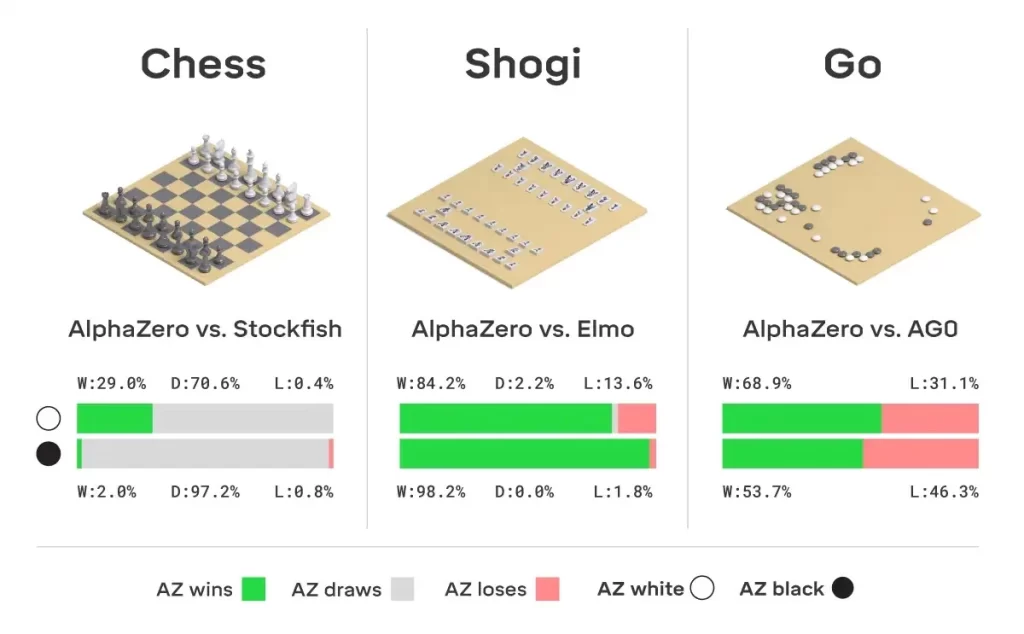
In addition to its achievements in board games, AlphaZero has also demonstrated the ability to accelerate the resolution of complex problems such as matrix multiplication.
Matrix multiplication is an essential calculation for a variety of applications, ranging from displaying images on a screen to simulating complex physical systems. Furthermore, it is also essential in aprendizaje automático .
In this way, AlphaZero surprised everyone by demonstrating that its reinforcement learning and self-learning approach could be applied to accelerate matrix multiplication, breaking the record that had stood for more than 50 years.
And to leave no doubt about its capabilities, the new version, called AlphaDev, has further accelerated calculations and increased the computational solution for sorting items in a list by 70%. In addition, it accelerated a fundamental algorithm used in cryptography by 30%.
AlphaZero has not only revolutionized the way AI learns and plays, but has also demonstrated its ability to generate perspectivas in other areas, accelerating computationally intensive processes.
4. Health and science:
Beyond gaming, DeepMind also focuses on applying its technologies to fields such as health and science.
In this way, DeepMind has developed AI algorithms capable of analyzing medical images and assisting in medical diagnoses, as well as modeling complex molecular interactions to advance scientific research.
5. Ethics and safety:
DeepMind has also demonstrated a commitment to AI ethics and safety. The company has contributed to the development of guidelines for responsible AI research by exploring ways to mitigate the potential risks associated with the advancement of artificial intelligence.