Inside Oracle Fusion Claw: A Governed Execution Runtime for Agentic Enterprise Applications
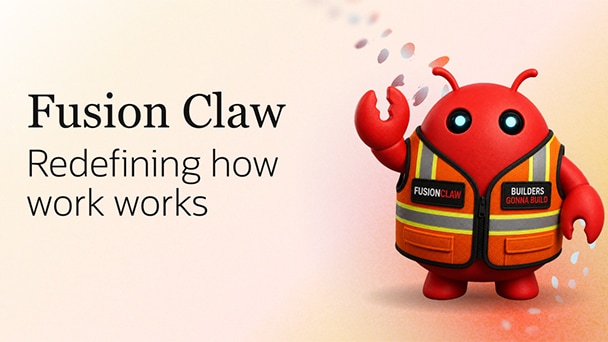
Oracle has introduced Fusion Claw, a runtime for its Fusion Agentic Applications that separates AI reasoning from deterministic execution. Alongside it come 25 new “Claw-powered” applications, joining a portfolio of 75 Agentic Applications. This article looks at the architecture Oracle describes, the governance model, and the open questions engineers and architects should ask.
Everything here is drawn from Oracle’s announcement. Where I go beyond it, I say so.
The core idea: reason once, execute deterministically
Oracle Fusion Claw: Most agent architectures today loop a large language model through every step of a task. That works for small jobs, but it gets expensive and unpredictable when the work involves thousands or millions of records, such as reconciling a ledger or evaluating staffing combinations.
Oracle’s answer is a two-phase split within each “Claw Outcome”:
- Reasoning phase. A frontier model reasons, plans, learns, and adapts. Oracle says Gemini and OpenAI models power this today, with more planned.
- Execution phase. Fusion Claw hands the plan to deterministic enterprise computation, which runs it precisely and at scale.
The economic argument follows from this. Model inference is applied only where judgment is needed, and high-volume work runs on conventional compute. That is the same principle behind an LLM writing a query or a script rather than reading every row itself. Oracle frames it as a “potential economic advantage,” which is cautious wording. Actual savings will depend on workload mix and how much of a given process can be planned up front.
The runtime also supports continuous replanning. Deterministic execution does not mean a fixed plan: the reasoning layer can revise the plan as conditions change, which matters for use cases like staffing and shipping where inputs shift constantly.
What the runtime adds
Oracle Fusion Claw: Oracle lists four capabilities that distinguish Claw from earlier Fusion agentic offerings:
- Larger scale and longer-running work, moving beyond short, conversational agent interactions
- Continuous replanning as data and constraints change
- Deterministic execution for precision and repeatability
- Increased governed autonomy, with configurable levels of automation
The last point is worth noting. Customers choose the automation level per process, from “quick assistance” up to “governed full auto execution within explicitly delegated authority.” All 25 launch applications are described as full-auto capable, though that is a ceiling, not a default.
The governance architecture
For enterprise adoption, the governance model is probably the most consequential part of the announcement. Oracle describes three interlocking constructs.
Enterprise Operating Envelope. This is the policy layer. It encodes an organization’s objectives, standard operating procedures, policies, constraints, permissions, risk thresholds, decision rights, approval requirements, and escalation boundaries. It defines what an agent may do and when it must stop and ask a human.
Outcome Trust Harness. This is the enforcement layer. It applies the envelope to each individual outcome run, scoping four things: identity, capabilities, data, and actions. Architecturally, this resembles per-run least-privilege scoping. An agent gets only the authority, tools, and data access a given outcome requires, rather than operating under a broad standing service account. Oracle doesn’t detail the enforcement mechanism, so the specifics of how policies are evaluated at runtime remain to be seen.
Outcome Receipt. This is the audit layer. Each completed outcome produces a record of the authority applied, evidence used, decisions made, actions and transactions executed, and the result. For regulated functions like finance and HR, a structured, per-outcome audit artifact is arguably a prerequisite for autonomous execution at all.
Together the three form a familiar control loop: define policy, enforce it at runtime, and record what happened.
Representative applications
Oracle highlights four of the 25 launch applications. Each pairs a search or optimization problem with governed action:
| Application | Domain | What it does |
|---|---|---|
| Ledger | Finance | Works across large volumes of accounting entries to reconcile, investigate exceptions and anomalies, and apply deterministic computation to complex financial analysis and execution |
| Workforce Staffing | HR | Builds executable staffing plans against constraints including skills and accreditations, availability, schedules, labor rules, and cost, evaluating alternatives and re-planning continuously |
| Shipping Consolidation | Supply chain | Models consolidation alternatives across timing, capacity, service commitments, and cost, then carries the best supported plan into governed execution when authorized |
| Account Territory Growth Plan | Sales | Models and compares territory configurations, weighing tradeoffs against capacity and business constraints before taking governed action |
These are constraint-heavy, high-volume problems, which is where the reasoning/execution split should pay off most. An LLM is well suited to interpreting goals, framing the problem, and explaining tradeoffs, while a deterministic engine is better suited to searching a large combinatorial space or matching millions of entries.
Where it fits in the Fusion AI stack
Oracle Fusion Claw: Claw-powered applications sit within a broader ecosystem anchored by Oracle AI Agent Studio for Fusion Applications. Its Agentic Applications Builder and AI Studio Skill provide no-code and pro-code paths for creating and managing agentic applications from reusable Oracle, partner, and external agents. Oracle also cites built-in observability, ROI measurement, and safety controls. The runtime itself runs on Oracle Cloud Infrastructure.
Oracle positions the overall shift as moving from a system of record to a “system of outcomes,” where people define objectives, authority, and accountability and the applications coordinate the process.
Questions worth asking
The announcement is a vendor press release, so it describes intent and design rather than measured results. Teams evaluating Fusion Claw should probe several areas:
- Determinism boundaries. Where exactly does the model’s plan end and deterministic execution begin? How is a plan validated before it runs, and what happens when execution diverges from it?
- Replanning behavior. How are replanning triggers defined, and how are oscillation or runaway replanning prevented in long-running outcomes?
- Policy enforcement. Is the Operating Envelope enforced outside the model, or does the model interpret it? Enforcement outside the model is far more robust.
- Receipt fidelity. How complete and tamper-evident are Outcome Receipts, and can they integrate with existing audit and GRC tooling?
- Cost evidence. What are real-world cost profiles versus a purely model-driven approach? The economic claim is plausible but unquantified.
- Model portability. Gemini and OpenAI are supported today with others planned. How are prompts, evaluations, and behavior kept consistent across models?
- Autonomy calibration. What evidence should a customer gather before moving a process from assisted to full-auto?
Assessment
Fusion Claw reflects a maturing pattern in enterprise agent design: use models for reasoning and planning, use conventional compute for volume and precision, and wrap the whole thing in explicit authority, scoped permissions, and audit records. The strongest part of the design, at least on paper, is treating governance as a runtime primitive rather than an afterthought. Whether it delivers on autonomy, cost, and trust will only become clear as customers put the 25 applications into production. Partner and analyst endorsements in the announcement (Accenture, Deloitte, KPMG, PwC, Google Cloud, IDC) signal ecosystem interest, but they aren’t independent validation of performance.
Source: Oracle’s announcement of Oracle Fusion Claw. Technical details beyond the announcement, including enforcement mechanics and benchmarks, were not provided and are flagged above as open questions.